Germany’s Hanns Seidel Foundation Is Now Accepting Scholarship Applications — But This One Asks More Than Your GPA
Most scholarship applications ask for grades, a transcript, and a motivation letter.
The Hanns Seidel Scholarships ask for something harder to fake: evidence that your education has been connected to something beyond yourself.
Community service. Civic engagement. Democratic participation. Voluntary work that serves the public good — documented, verified, and submitted with your application. Strong academic performance still matters here. But so does what you’ve done with your time outside the lecture hall.
The foundation’s 2026 application cycle is now open. The current window runs until July 15, 2026 — which means the deadline is closer than it appears. A second window opens in December for those who need more preparation time.
Here’s everything applicants need to understand before applying.
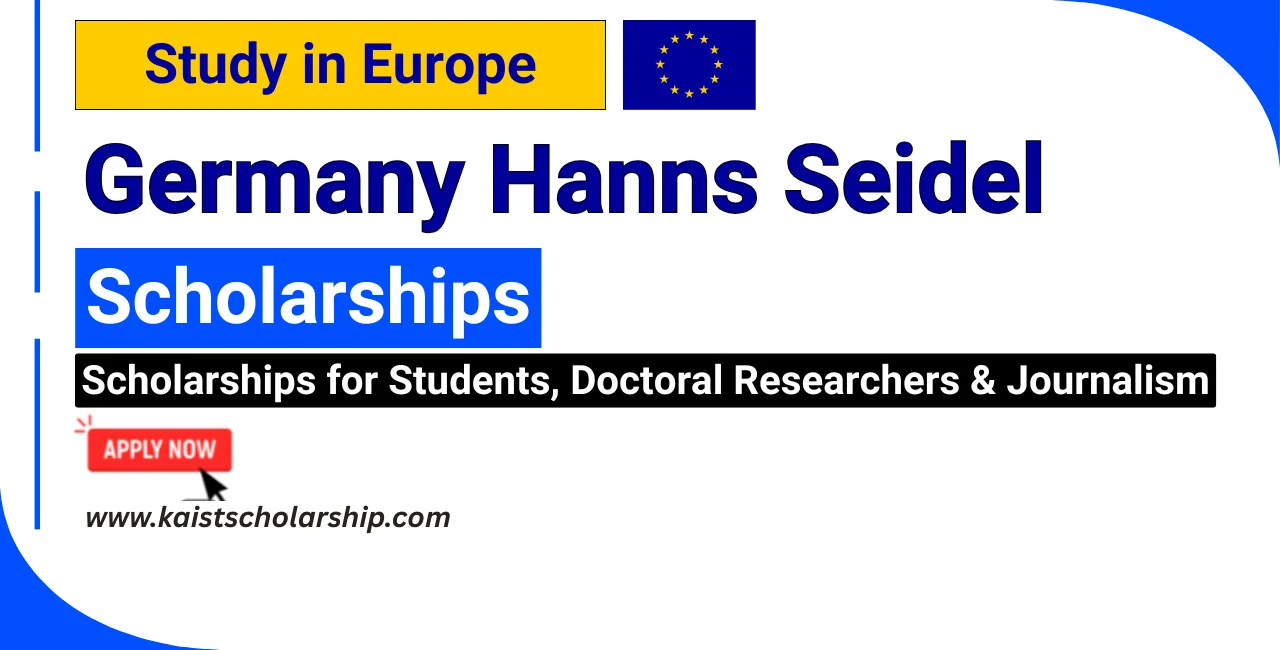
Germany Hanns Seidel Scholarships Overview
| Foundation | Hanns Seidel Foundation, Germany |
| Opportunity | Scholarships for students, doctoral researchers & journalism |
| Who Can Apply | International students & doctoral candidates connected to Germany |
| German Language | B2 level minimum — hard requirement |
| Window 1 Open | June 15, 2026 |
| Window 1 Closes | July 15, 2026 |
| Window 2 Open | December 15, 2026 |
| Window 2 Closes | January 15, 2027 |
| Application | Portal-based — incomplete applications cannot be submitted |
What Kind of Scholarship This Actually Is
The Hanns Seidel Foundation is one of Germany’s six major politically affiliated foundations — connected to the Christian Social Union (CSU). That affiliation shapes the scholarship’s character in a specific way.
This program isn’t looking for academically excellent students who happen to need funding. It’s looking for people who combine academic ability with a demonstrated commitment to democratic values, social responsibility, and active participation in public life.
That distinction matters enormously for how you approach the application.
An applicant with a strong academic record but no documented community engagement is at a significant disadvantage here compared to a slightly less decorated academic who has spent years contributing to student government, youth initiatives, civic campaigns, or public-interest organizations — and can prove it with proper documentation.
The foundation is explicit about what counts as voluntary work: it must be unpaid, active, outside private life, oriented toward the common good, and grounded in democratic values and tolerance. Vague claims — “I helped my community” or “I participated in social activities” — will not be sufficient. You need formal certificates or confirmation letters that verify your contributions specifically.
The Two Application Windows — Which One Is Right for You?
The foundation runs two cycles per year. They cover slightly different tracks, so it’s worth understanding which window applies to your situation.
Window 1 — Open Now June 15, 2026 → July 15, 2026
This window is open for:
- The Journalistic Support Program
- The doctoral program “Actively Shaping the Future”
- International student and doctoral candidate funding
If you’re an international applicant planning to study or conduct doctoral research in Germany, this window is relevant to you right now.
Window 2 — Opens December 2026 December 15, 2026 → January 15, 2027
This window covers:
- Student funding
- Doctoral candidate funding
- International student and doctoral candidate funding
If your documents aren’t ready for July, the December window gives you a second chance. But don’t treat that as an excuse to delay preparation — the document requirements are substantial, and assembling them from scratch in December will be difficult if you haven’t started.
Who Should Apply
The scholarship is relevant to several distinct groups. Understanding which category fits your situation determines which track you apply under.
International students may apply for student funding if they can demonstrate strong academic performance, a clear study and career direction, and documented voluntary engagement in the public sphere.
International doctoral candidates may apply with a well-developed dissertation project, confirmed academic supervision, and evidence of both academic strength and social commitment.
Journalism-track applicants — students combining academic study with media work, reporting, public communication, or civic journalism — can apply under the Journalistic Support Program during Window 1. This track requires the submission of relevant work samples.
One critical requirement for all international applicants: German language proficiency at B2 level or above.
This is a hard filter, not a soft preference. Applications without verified proof of German language ability will not be considered. If you are not yet at B2, that is the most important thing to work on before either application window.
A Category to Avoid
There is one funding track listed in the foundation’s portal that international applicants should not apply under: internal funding reserved for current HSS scholarship holders.
This category exists only for students and doctoral candidates who already receive Hanns Seidel Foundation support and are applying for continuation or supplementary funding. Applications submitted under this category by non-HSS recipients will be deleted.
It’s a small detail that wastes significant time if overlooked. Read the category descriptions carefully before selecting your application track.
What the Application Requires
The portal doesn’t allow incomplete submissions — which means you need every document ready before you begin filling out the form, not while you’re in the middle of it.
For all applicants:
- Academic transcripts and degree certificates
- Proof of German language proficiency (B2 minimum)
- Study plan or doctoral research plan
- Evidence of voluntary engagement (formal certificates or confirmation letters — not self-descriptions)
- Academic recommendation letters
- Personal statement connecting your goals to the foundation’s values
Additional requirement for journalism-track applicants:
- Up to five work samples or links to multimedia, radio, or television work demonstrating journalistic output
The voluntary engagement documentation deserves particular attention. Many applicants underestimate how strictly the foundation interprets this requirement. A letter from an organization confirming your role, duration, and contributions carries weight. A paragraph in your personal statement describing what you did does not, on its own, fulfill the requirement.
What Makes an Application Stand Out
Meeting the eligibility criteria gets you into the competition. It doesn’t make you competitive.
The Hanns Seidel Foundation receives applications from across Germany and internationally. Applicants who succeed typically combine several things that individually aren’t enough on their own.
Strong academic performance is the baseline — but it’s the starting point, not the deciding factor. What separates funded candidates from rejected ones is usually the quality and specificity of the research or study plan, the depth and documentation of civic engagement, and the coherence between the applicant’s stated values and the foundation’s own commitments to democratic participation and public service.
Generic statements about wanting to “contribute to society” won’t distinguish your application. Specific, documented evidence of having already contributed — in ways that align with the foundation’s framework — will.
For journalism applicants specifically: work samples matter more than your description of your journalistic ambitions. Submit the best five pieces you have. Let the work speak before the personal statement does.
The German Language Requirement — Don’t Underestimate It
B2 is the European standard for upper-intermediate German. It means you can understand the main ideas of complex text, interact with a degree of fluency, and express yourself clearly on a range of subjects.
For many international applicants, this is the barrier that determines whether they apply now or prepare for a future cycle.
Accepted proof typically includes recognized language certificates such as Goethe-Zertifikat B2, TestDaF, DSH, or equivalent qualifications. Check the foundation’s official portal for the specific certificates they accept — requirements can be updated, and it’s worth confirming current standards before assuming your certificate qualifies.
If you’re close to B2 but haven’t tested yet, pursuing certification before the December window is a concrete and achievable goal.
Related reading: