
Here is something most students don’t realize until they’re already deep into researching Korean universities.
At KAIST, the full scholarship isn’t something you compete for separately. Every international undergraduate student receives full financial support covering tuition and living expenses — automatically, as part of admission itself.
No separate scholarship application. No merit cutoff to clear after getting in. You’re admitted, and the funding comes with it.
That single fact changes how KAIST should be evaluated against other universities. Add a #24 global ranking in Engineering and Technology (QS 2025), the freedom to explore STEM for a full year before choosing a major, and a campus that operates entirely in English — and the case for applying becomes worth understanding in detail.
This guide covers everything international applicants need to know about KAIST’s 2027 undergraduate admissions: who qualifies, what the deadlines are, what documents are required, how the application works, and what the selection process actually evaluates.
KAIST Undergraduate Scholarships Overview
| Detail | Information |
|---|---|
| University | KAIST (Korea Advanced Institute of Science and Technology) |
| Location | Daejeon, South Korea |
| Language | English (most courses conducted in English) |
| Scholarship | Fully Funded |
| Major Declaration | Not required at entry — declared in second year |
| Application Tracks | Early and Regular |
| Early Deadline (2027 ref.) | October 22, 2026 |
| Regular Deadline (2027 ref.) | January 14, 2027 |
| Application Fee | USD 80 (non-refundable) |
| Contact | creative.adm@kaist.ac.kr |
The KAIST Full Scholarship Coverage
Every international undergraduate admitted to KAIST receives financial support covering both tuition and living expenses. This is not a competitive award. It comes with admission.
For the student visa application process, KAIST generally requires applicants to demonstrate a bank balance of approximately USD 3,200 (accounting for the annual KAIST scholarship of approximately KRW 11,786,000 against the KRW 16,000,000 typically required for visa purposes).
This means applicants need to show some initial funds even with the scholarship — but the ongoing financial burden of tuition and living costs is covered throughout the degree.
Why KAIST — The Facts Worth Knowing
Before the application details, a few things that distinguish KAIST from most other universities recruiting international students.
| Feature | Detail |
|---|---|
| Full Scholarship | All international undergraduates receive tuition + living expenses |
| Global Ranking | #24 worldwide in Engineering & Technology (QS 2025) |
| Korea Ranking | #1 in Korea |
| Language | English-medium instruction throughout |
| Major Declaration | Not required at entry — students choose in their second year |
| Transfer Credits | Not accepted — all admitted students enroll as freshmen |
| Research Access | Undergraduate Research Participation (URP) Program available |
The undeclared major system deserves particular attention. Most universities require students to commit to a field before they arrive. KAIST gives students their entire first year to attend academic fairs, take introductory courses across disciplines, and make an informed decision. That flexibility is genuinely rare at a research university of this caliber.
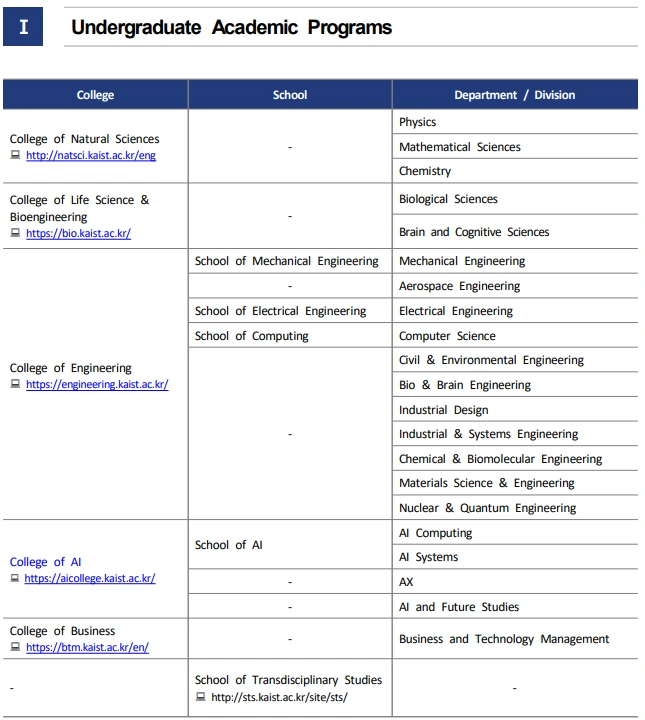
KAIST Undergraduate Academic Programs
1. College of Engineering
School of Computing
- Computer Science
School of Electrical Engineering
- Electrical Engineering
School of Mechanical Engineering
- Mechanical Engineering
- Aerospace Engineering
Other Departments
- Civil & Environmental Engineering
- Materials Science & Engineering
- Chemical & Biomolecular Engineering
- Industrial & Systems Engineering
- Industrial Design
- Bio & Brain Engineering
- Nuclear & Quantum Engineering
2. College of AI
School of AI
- AI Systems
- AI Computing
Other Divisions
- AI and Future Studies
- AX
3. College of Natural Sciences
- Chemistry
- Physics
- Mathematical Sciences
4. College of Business
- Business and Technology Management
5. College of Life Science & Bioengineering
- Brain and Cognitive Sciences
- Biological Sciences
6. School of Transdisciplinary Studies
- Transdisciplinary Studies
The Eligibility Rules — Read These Carefully
This is where many international applicants go wrong. The rules around Korean origin and citizenship are specific and non-negotiable.
The Two Core Requirements
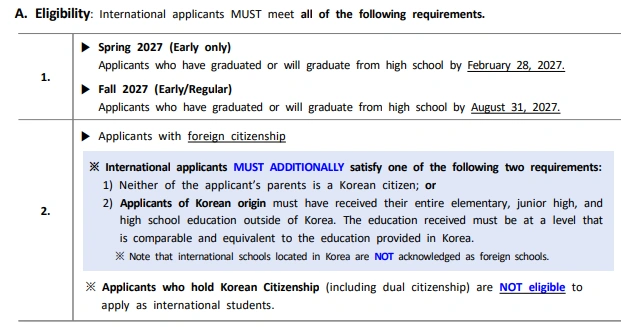
Every international applicant must satisfy both of the following:
1. Graduation timing
- Spring 2027 entry (Early track only): High school graduation by February 28, 2027
- Fall 2027 entry (Early or Regular track): High school graduation by August 31, 2027
2. Citizenship and origin
Applicants must hold foreign citizenship AND satisfy one of the following:
- Neither parent holds Korean citizenship, OR
- The applicant is of Korean origin but completed their entire elementary, junior high, and high school education outside Korea at a level comparable to Korean education standards
Two important clarifications from the official guide:
International schools located inside Korea are not recognized as foreign schools for this purpose.
Applicants holding Korean citizenship — including dual citizenship — are not eligible to apply as international students. No exceptions.
If You Graduated From High School in Korea
International students who graduated from a Korean high school can still apply, under a separate eligibility track. Requirements are stricter: both the applicant and both parents must hold non-Korean citizenship. Dual citizens are again excluded.
The Documents You Need
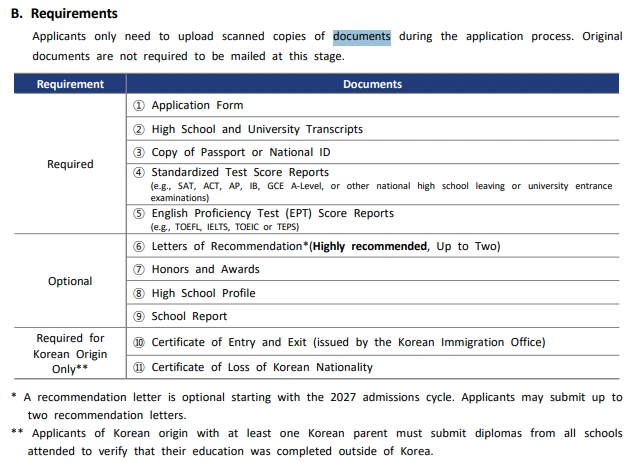
KAIST only requires scanned copies during the application process. Original documents are not mailed at this stage — they’re required later if you’re admitted.
Required for All International Applicants
Application form — completed through the online portal at univapply.kaist.ac.kr/interapply/
High school and university transcripts — official transcripts from all high schools attended. If you’re currently enrolled at a university, submit transcripts from both institutions. Transcripts should cover your final two to three years of high school, including courses currently in progress.
Passport or national ID copy — must clearly show your passport number, photo, name, and issue and expiration dates.
Standardized test score reports — at least one official score from SAT, ACT, AP, IB, GCE A-Level, or another recognized national high school leaving or university entrance examination. KAIST particularly values strong results in mathematics and science.
For SAT and AP scores, use KAIST’s institution code 4433. For ACT, use 7778. For IB, use 000559. Scores submitted through official online reporting systems don’t require hard copies later. Scores sent as PDFs will require apostilled originals if you’re admitted.
English Proficiency Test (EPT) scores — required from all applicants unless exempt.
English Proficiency Requirements
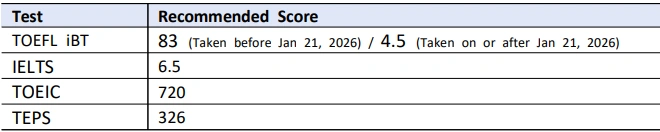
KAIST teaches entirely in English. All international applicants must submit at least one of the following:
| Test | Recommended Score |
|---|---|
| TOEFL iBT | 83 (taken before Jan 21, 2026) / 4.5 (taken on or after Jan 21, 2026) |
| IELTS | 6.5 |
| TOEIC | 720 |
| TEPS | 326 |
Scores must remain valid (within two years) as of the application deadline. Earliest accepted test dates:

- Early Track: November 12, 2024
- Regular Track: February 4, 2025
For detailed information about accepted tests, minimum scores, and exemptions, see our KAIST English Proficiency Requirements
Not accepted: Institutional Testing Program (ITP), Duolingo English Test (DET), and at-home or online test versions.
EPT exemptions apply to:
- Nationals of English-speaking countries including Australia, Canada, Ireland, New Zealand, the UK, the US, and others listed in the official guide
- Applicants who completed high school where English was the medium of instruction — a certificate from the school confirming this is required
Optional Documents (Strongly Recommended)
- Letters of recommendation: optional from the 2027 cycle onward, but highly recommended. Up to two letters, written in English, submitted directly by the recommender through the KAIST portal. Hard copies and email submissions are not accepted.
- Honors and awards: up to five, with supporting documentation
- High school profile: official school brochure or Ministry of Education document, maximum five pages
- School report: official document from your high school covering academic context and grading scale
Two Application Tracks — Early and Regular
KAIST runs two tracks each year. Understanding the difference helps you decide which fits your situation.
Early Track
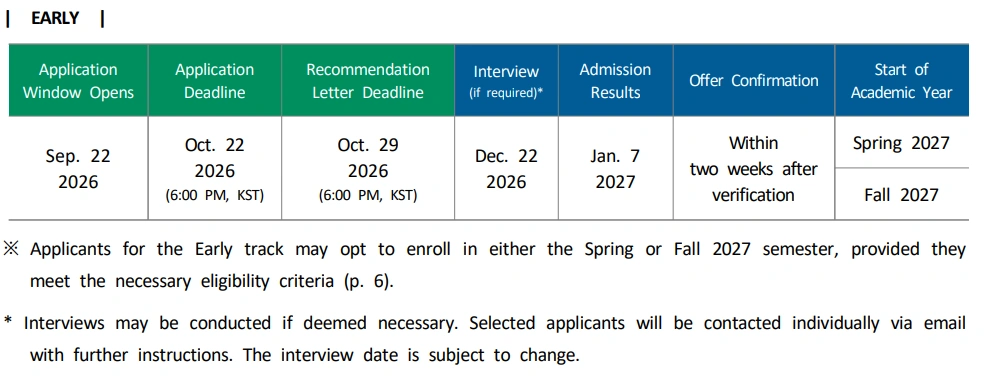
Opens: September 22, 2026 (2027 reference cycle)
The Early track is the only path to Spring 2027 enrollment. Successful Early applicants can choose to start in either Spring or Fall 2027 if they meet the relevant eligibility criteria. Applicants who prefer Fall entry can also use the Early track.
| Milestone | Date (2027 ref.) |
|---|---|
| Application opens | September 22, 2026 |
| Application deadline | October 22, 2026 (6:00 PM KST) |
| Recommendation letter deadline | October 29, 2026 (6:00 PM KST) |
| Interview (if required) | December 22, 2026 |
| Admission results | January 7, 2027 |
| Start of academic year | Spring or Fall 2027 |
Regular Track
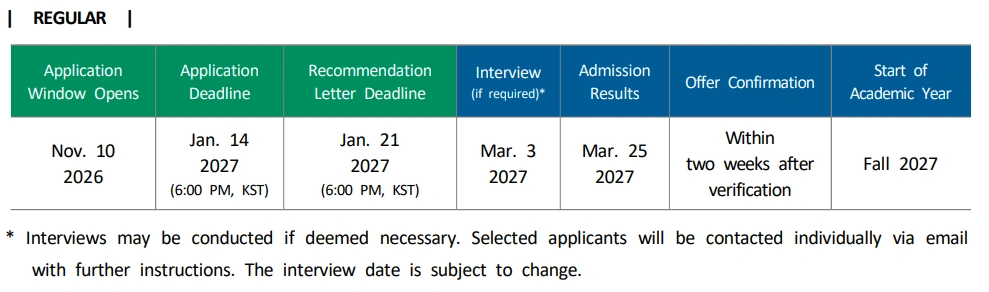
The Regular track leads to Fall 2027 enrollment only.
| Milestone | Date (2027 ref.) |
|---|---|
| Application opens | November 10, 2026 |
| Application deadline | January 14, 2027 (6:00 PM KST) |
| Recommendation letter deadline | January 21, 2027 (6:00 PM KST) |
| Interview (if required) | March 3, 2027 |
| Admission results | March 25, 2027 |
| Start of academic year | Fall 2027 |
Critical rule: Once the application fee is paid, the track cannot be changed. Decide before you pay, not after.
All deadlines are in Korean Standard Time. KAIST strongly advises submitting at least one week before the deadline, not on the final day.
How to Apply for KAIST Undergraduate Scholarship
Step 1: Review the official admissions guidelines and FAQs at admission.kaist.ac.kr/intl-undergraduate
Step 2: Create an account and complete the online application at univapply.kaist.ac.kr/interapply/
Step 3: Upload scanned copies of all required documents
Step 4: Review everything — check all information is accurate and the recommender’s email address is correct
Step 5: Pay the application fee (USD 80). Once paid, the track cannot be changed and the fee is non-refundable
Step 6: Confirm that recommendation letter requests have been sent automatically to your recommenders. Letters must be submitted by recommenders through the KAIST portal — not by email or hard copy
Step 7: Log in and verify all documents have been successfully uploaded. This is the applicant’s sole responsibility — KAIST will not send individual confirmation
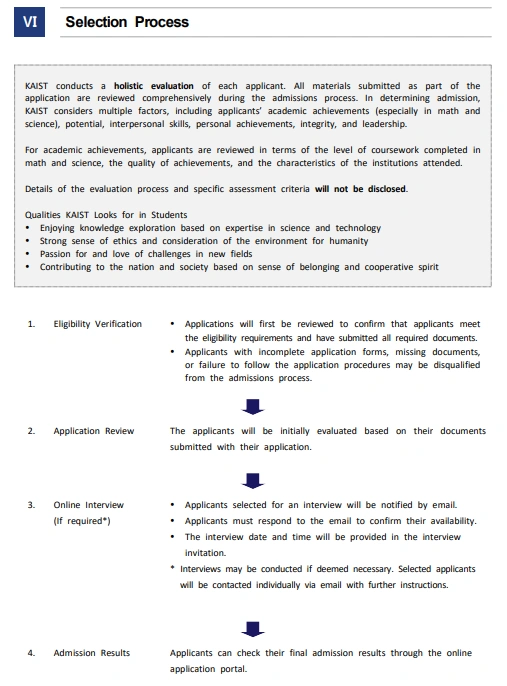
Step 8: Attend an online interview if contacted (not required for all)
Step 9: Check results at univapply.kaist.ac.kr/interapply/
If you need to contact a professor about your academic interests or research then see our guide on How to Email KAIST Professors for tips and examples
Application fee payment options:
- Credit card (domestic or international) — most straightforward
- Domestic bank transfer (Korean bank) — remittance receipt required by email to creative.adm@kaist.ac.kr
- International bank transfer (USD 80) — initiate at least three weeks before the deadline; bank transfer fees are covered by the applicant
The Essays — What KAIST Is Actually Asking
The essay prompts are included in the application form. This is the section most guides summarize too quickly. The prompts reveal a great deal about what kind of student KAIST is trying to identify.
Five prompts appear in the 2027 application:
Q1 — Your STEM question (300 characters for the question, 1,600 for the explanation)
Write a question in STEM that sets you apart — and explain what inspired you to ask it. KAIST is explicit that this is not about the question’s academic merit. They’re assessing your curiosity, attitude, and spirit of inquiry. Research and extracurricular activities are specifically mentioned as things to avoid centering the response on. Personal story is what they want.
Q2 — Meaningful activities in high school (1,500 characters)
Up to three curricular or extracurricular activities you devoted yourself to, with focus on what you learned and felt — not just what you did. Achievements matter less here than genuine reflection.
Q3 — Thinking differently (1,500 characters)
Describe cases where you thought or acted differently from others, and how that affected you and the people around you. KAIST wants evidence of independent thinking and its real-world impact.
Q4 — Cooperation and consideration (1,500 characters)
Concrete examples of practicing consideration, sharing, cooperation, or conflict resolution — with reflection on what you learned from the experience. This prompt is specifically targeting character, not achievement.
Q5 — Background and difficulties (1,000 characters)
Optional additional context about family background or challenges overcome. This is the space to share circumstances that don’t appear elsewhere in your application.
Reading these five prompts together, the picture of what KAIST wants is clear: a student with genuine intellectual curiosity, real self-awareness, ethical grounding, and the ability to work with and for others. Strong grades and test scores get you through the door. The essays reveal whether you’re the kind of person KAIST wants inside it.
The Application Fee and Waiver Program
The application fee is USD 80, non-refundable. Payment is accepted by credit card, domestic Korean bank transfer, or international bank transfer.
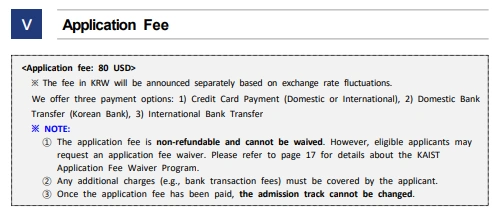
International bank transfers can take several weeks to process. Applicants paying by international transfer should initiate it at least three weeks before the application deadline. For complete details, check our KAIST Application Fee Guide.
Fee Waiver — Often Overlooked
KAIST offers an application fee waiver for exceptional students from UN-designated Least Developed Countries (LDCs), provided they rank within the top 5% of their grade and have been resident in the LDC country since birth.
Eligible regions include 32 African countries, 8 Asian countries (including Afghanistan, Bangladesh, Cambodia, Myanmar, Nepal, and Yemen), Haiti, and three Pacific nations. The full list appears in the official admissions guide.
Fee waiver request periods for 2027:
- Early track: August 25 to September 3, 2026
- Regular track: October 6 to October 15, 2026
Results are announced two to three days before the relevant application window opens. If a waiver request is not approved, the standard fee applies.
After Admission — Documents for Admitted Students
Getting the offer is not the final step. Admitted students must send original documents by international mail to the KAIST Office of Admissions within a specified period announced with the results.
These documents are required before KAIST can issue the Certificate of Admission needed for the student visa application.
Required documents after admission include:
- Passport copy (applicant) and identity documents from both parents
- Certificate of family registration or birth certificate showing the family relationship
- Bank statement showing approximately USD 3,200 — this accounts for the KAIST scholarship value (approximately KRW 11,786,000 annually) against the standard KRW 16,000,000 visa requirement
- Apostilled high school diploma, official transcripts, and standardized test certificates (required only for applicants who submitted scores as PDF files; scores submitted through official online reporting systems are exempt from hard copy requirements)
A note on Apostilles: An Apostille is an internationally recognized certification authenticating public documents under the Hague Convention. If your country is not a member of the Apostille Convention, consular legalization through your Ministry of Foreign Affairs and the Korean Embassy is required instead. Documents from private schools must first be notarized before an Apostille can be issued.
Things Applicants Consistently Get Wrong
A few patterns come up repeatedly in applications that cause avoidable problems.
Leaving recommendation letters until the last day. The recommender receives an automated email only after you pay the application fee. If you pay two days before the deadline, your recommender has two days. Give them more time than that.
Using a local or institutional email for the recommender. KAIST specifically advises using Gmail or Yahoo for recommenders’ email addresses. Emails to local email services are frequently filtered or blocked. A recommendation letter that never arrives is one that was never submitted.
Assuming the track can be changed. Once the fee is paid, your track is fixed. Decide carefully between Early and Regular before completing payment.
Submitting test scores too late. SAT, AP, and ACT scores sent through official reporting take one to two weeks to reach KAIST. Budget for this delay before the deadline, not after.
Misunderstanding the dual citizenship rule. Holding dual Korean-foreign citizenship does not make you eligible to apply as an international student. This applies even if you’ve lived abroad your entire life. The rule is clear in the official guide and is not subject to interpretation.