
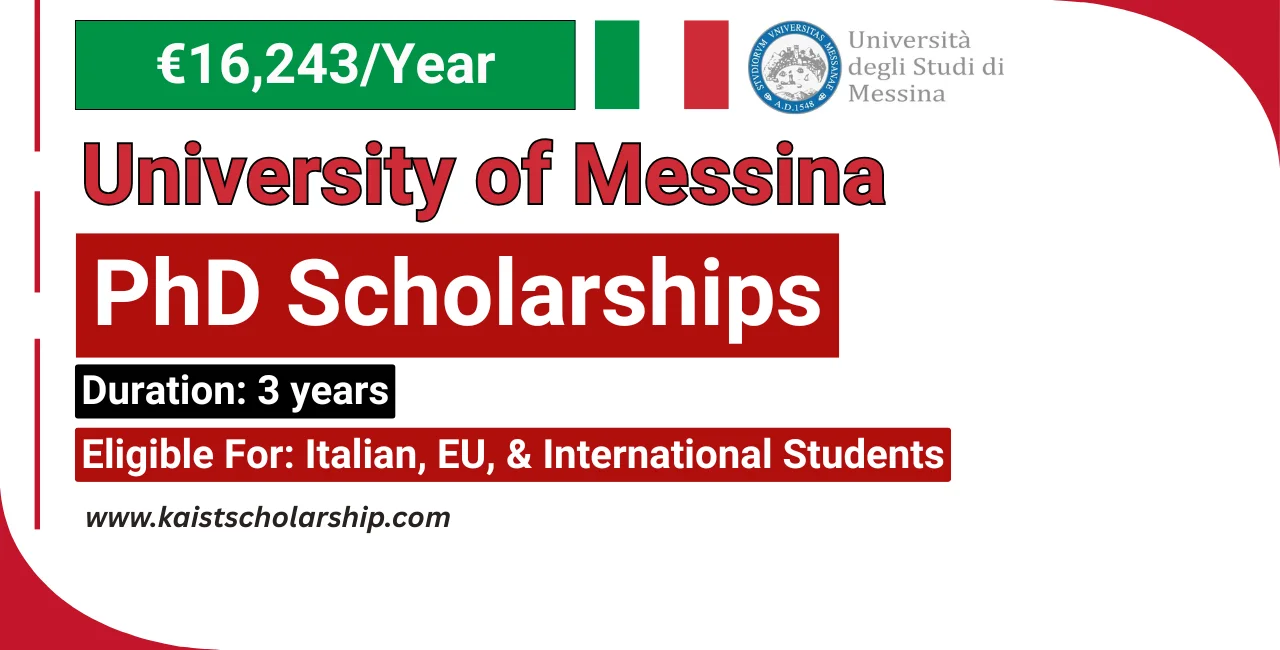
The University of Messina Is Offering Fully Funded PhDs Across 15 Fields — But the Deadline Is July 24
If you’ve been waiting for the right PhD opportunity, this one deserves your attention this week — not next month.
The University of Messina has opened applications for its 42nd Cycle PhD Programs for the 2026/2027 academic year, with a firm deadline of 24 July 2026 at 11:59 PM Italy time. That’s weeks away. And with 15 doctoral programs spanning engineering, medicine, economics, law, physics, psychology, sustainability, and more — alongside fully funded scholarships, industry partnerships, and international mobility support — this is one of the most comprehensive doctoral calls Italy has published this year.
Applications for the Messina PhD Scholarships are open to Italian, European, and international students from every country. There are no nationality restrictions and no age limits for standard admission.
University of Messina PhD Scholarships Overview
| University | University of Messina, Italy |
| Programs Available | 15 doctoral programs |
| Duration | 3 years |
| Annual Scholarship | €16,243 |
| Who Can Apply | Italian, EU, and international students |
| Application Deadline | 24 July 2026 — 11:59 PM Italy Time |
What the Scholarship Covers
Many positions come with fully funded doctoral scholarships. Here’s what recipients receive:
- €16,243 annual scholarship, paid monthly
- Research funding for approved activities
- International mobility support — including additional funding for authorized research periods abroad
- Access to advanced university laboratories
- Academic supervision from internationally recognized faculty
- Industry partnership opportunities
- Professional research training
The international mobility element is worth highlighting. Scholarship recipients don’t just receive a fixed annual amount — additional research budgets are available for approved overseas research stays. For doctoral candidates planning international collaborations, that’s a meaningful addition to the base package.
Beyond funded positions, the call also includes non-scholarship places and industry-funded research positions supported by private companies and national agencies. The range of funding types is broader than most Italian doctoral calls.
15 Programs — Something for Almost Every Researcher
Fifteen doctoral programs is an unusually wide scope for a single university’s PhD call. What makes Messina’s 42nd Cycle particularly interesting is that the programs don’t cluster in one faculty — they genuinely span the full range of academic disciplines.
Here’s what’s available and what makes each program worth knowing about.
Engineering
This is the largest and most varied program in the call.
Research areas span mechanical, computer, civil, electrical, naval, aerospace, environmental, materials, and telecommunications engineering — alongside cybersecurity, artificial intelligence, renewable energy, and hydrogen technology.
What makes this program stand out: industry-funded scholarships are available through some significant partners. The National Cybersecurity Agency is directly funding positions, as are Novamarine, Vishay Semiconductor, and others. Several scholarships include international mobility, company placements, and overseas research periods built into the doctoral structure.
For engineers who want a PhD that connects academic research with real industry application, this program structure is genuinely unusual.
Bioengineering Applied to Medical Sciences
Research areas include biomedical engineering, medical imaging, AI in healthcare, biotechnology, and dental sciences.
4 University/MUR scholarships are available alongside 1 non-scholarship position. The intersection of AI and medical technology makes this one of the more forward-looking programs in the call.
Physics
Covering quantum physics, astrophysics, materials science, experimental and theoretical physics. 4 scholarships plus 1 non-funded position. For physics researchers looking for a European doctoral program with genuine research depth, Messina’s physics faculty has a strong track record.
Chemical Sciences
Pharmaceutical chemistry, food chemistry, molecular systems, functional materials, and nutraceuticals. 4 scholarships available. The food chemistry and nutraceuticals angle gives this program a distinctive applied dimension alongside the more traditional chemical research tracks.
Economics, Management andStatistics
One of the more distinctive programs in the call — and not just because of the subject matter.
This program includes Executive PhD positions funded through industry partnerships with companies including Biofuture Medicine and DPT Consulting. Research tracks include AI for biomedical management, sustainable innovation, circular economy, and corporate sustainability.
Executive PhD positions typically allow candidates to remain employed while pursuing doctoral research — though specific eligibility conditions apply. If you’re currently working in industry and considering a doctorate, this track is worth examining carefully.
Applied Biology and Experimental Medicine
Experimental medicine, biological and environmental sciences, and pharmaceutical sciences. 4 scholarships and 1 non-funded position available.
Psychology
Clinical, educational, cognitive, and health psychology, alongside rehabilitation sciences. Funded through both University of Messina scholarships and University of Catanzaro scholarships — an inter-institutional funding arrangement that’s relatively uncommon.
Additional Programs
The call also includes doctoral programs in:
- Cognitive Sciences
- Public Administration Sciences
- Legal Sciences
- Political Science
- Humanities
- Veterinary, Biotechnological and Agricultural Sciences
- Sustainability Sciences
- Translational Molecular Medicine and Surgery
Each program carries its own admission criteria, examination requirements, scholarship allocations, and curriculum structure. Review the specific program documentation before applying — requirements differ significantly across disciplines.
Who Can Apply
The eligibility framework is deliberately inclusive.
You can apply if you:
- Hold a Master’s degree, equivalent postgraduate qualification, or a foreign degree recognized for admission
- Are completing your Master’s degree and will obtain it before 31 October 2026 — you can still apply now
- Are Italian, European, or an international student from any country
- Meet any subject-specific requirements for your chosen program
Additional requirements vary by program:
- Some programs require a specific academic background
- Some require English or Italian language proficiency evidence
- Some require a research proposal
- Executive PhD positions require employment with affiliated partner companies
- High-level apprenticeship positions carry additional age requirements
One detail that catches many international applicants off guard: if you’re still finishing your Master’s degree, you are not automatically excluded. You simply need to complete your qualification before the program begins on November 1. That window matters — check whether your graduation timeline fits.
The Selection Process
Admission is competitive and assessed across multiple dimensions.
The evaluation typically considers:
- Academic qualifications and transcripts
- Research proposal (where required by the program)
- Written examination (for selected programs)
- Oral interview — which may be conducted online or in mixed mode depending on the program
The committee also weighs research potential, publications (if any), professional experience, motivation, and language proficiency where relevant.
One practical note: strong academic results alone are not sufficient for the most competitive positions. Applicants for industry-funded scholarships and positions linked to specific research projects should demonstrate a clear connection between their background and the project’s research focus.
What International Applicants Need to Know
Applying from outside Italy involves a few extra steps that domestic applicants don’t face — and it’s worth knowing about them before you start.
For the application portal: International applicants without Italy’s SPID digital identity can register through the University’s Esse3 platform using dedicated credentials provided during registration. This is not an obstacle, but you’ll need to allow a little extra time for the registration process.
For visa and enrollment: Students admitted from outside the European Union will need to complete visa and pre-enrollment procedures through the Universitaly portal where applicable. This is separate from the PhD application itself and involves Italian immigration processes.
For academic documents: International applicants with foreign qualifications must provide translated academic documents where required. Check the specific requirements for your program — translation requirements vary.
Start these processes early. Three weeks before a deadline is not enough time to navigate document translation, portal registration, and application preparation simultaneously.
Documents You’ll Need to Prepare
Most programs require the following:
- Europass or academic CV
- Master’s degree certificate or equivalent documentation
- Academic transcripts
- Research proposal (where required by your program)
- Master’s thesis
- Publications (if available)
- Professional experience documents
- Identity document
- Additional declarations and forms specified by the university
Check your specific program’s requirements carefully. Some disciplines ask for additional materials not listed here.
Official Link
University of Messina PhD Scholarships
Related reading: