
The idea is straightforward but genuinely powerful.
A student from Uganda studies medicine in Kenya. A Rwandan researcher pursues a Master’s in Tanzania. A young professional from Burundi completes a PhD in Uganda. They cross a border, earn a degree at a respected regional university, build networks across East Africa, and return home with something their peers don’t have: a career built on regional perspective rather than a single national context.
That’s what the East African Community Student Mobility Scholarship Scheme makes possible — and applications for the 2026/2027 cycle are open right now.
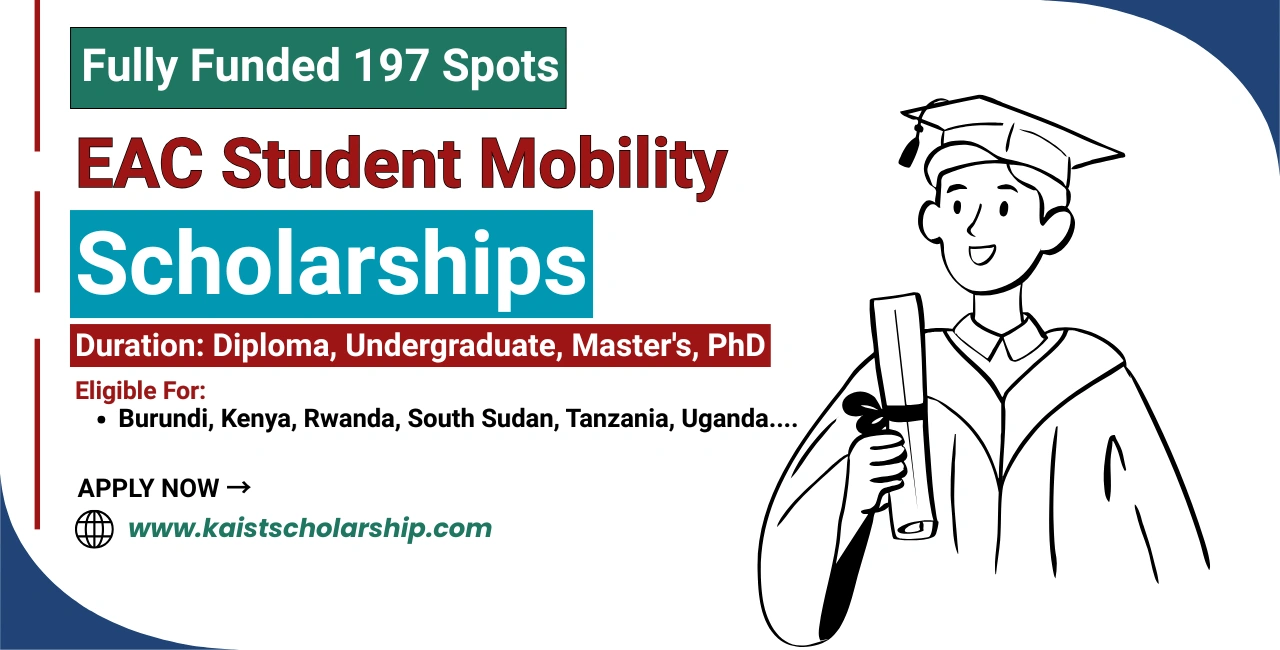
197 scholarships. 28 universities. 6 countries. Deadline: 20 August 2026.
EAC Student Mobility Scholarship Overview
| Scholarship | EAC Student Mobility Scholarship Scheme |
| Coordinating Body | Inter-University Council for East Africa (IUCEA) |
| Study Levels | Diploma, Undergraduate, Master’s, PhD |
| Total Scholarships | 197 |
| Universities | 28 across 6 countries |
| Eligible Countries | Burundi, Kenya, Rwanda, South Sudan, Tanzania, Uganda |
| Application Fee | None |
| Deadline | 20 August 2026 |
Scholarship Breakdown by Level
| Study Level | Scholarships Available |
|---|---|
| Undergraduate | 95 |
| Master’s | 90 |
| PhD | 11 |
| Diploma | 1 |
| Total | 197 |
The 95 undergraduate and 90 Master’s positions make up the majority of awards. PhD positions are the most competitive at just 11 available across the entire region.
How the Funding Is Split — And What It Covers
This is a cost-sharing scholarship, which means the financial support is divided between two parties. Understanding who covers what matters before you apply.
Host universities pay for:
- 100% of tuition fees
- Examination fees
IUCEA pays for:
- International travel expenses
- Health insurance
- Research support (Master’s and PhD students only)
Students or families cover:
- Accommodation
- Daily living expenses
- Any other university costs not listed above
The scholarship removes the largest financial barriers — tuition and travel — while students remain responsible for day-to-day living costs in their host country. For most applicants, that’s a workable arrangement. For others, it’s worth calculating accommodation and living costs in the target city before committing to an application.
Also See: Umeå University IceLab Postdoctoral Scholarships 2027 (Sweden)
Where You Can Study
Scholarships are available at 28 universities across these six EAC Partner States:
- Burundi
- Kenya
- Rwanda
- South Sudan
- Tanzania
- Uganda
One rule applies to everyone: you must study in a country different from your own. A Kenyan student cannot use this scholarship to study in Kenya. The entire program is built around cross-border mobility.
164 academic programs are on offer across these institutions, spanning a broad range of disciplines.
Fields of Study
The range is wide. Available programs include:
Medicine and Health
- Medicine
- Nursing
- Public Health
- Food Security
Sciences and Technology
- Computer Science
- Information Technology
- Cyber Security
- Statistics
- Biotechnology
- Astronomy
- Health Informatics
Engineering and Environment
- Engineering,
- Renewable Energy,
- Environmental Science,
- Climate Change,
- Sustainable Agriculture
Business and Economics
- Business Administration,
- Economics
- Finance
- Entrepreneurship
- Project Planning and Management
- Monitoring and Evaluation
Social Sciences and Humanities
- International Studies
- Peace and Conflict Studies
- Development Studies
- Social Work
- Tourism
- Education
- Law
- Regional Integration
- Swahili Studies
Browse the full program list on the IUCEA portal to find your specific field and shortlist universities before applying.
Who Qualifies (Eligibility)
Before preparing documents, confirm you meet every requirement.
All applicants must:
- Hold nationality and residency in an EAC Partner State
- Apply to study in a different EAC country (not their home country)
- Meet the admission requirements of their chosen university
- Demonstrate strong academic performance
For Master’s applicants:
- Minimum Upper Second-Class Honours degree (or equivalent)
- Must be under 35 years of age
For PhD applicants:
- Minimum Upper Second-Class Honours degree (or equivalent)
- Must be under 45 years of age
- Relevant work experience is an advantage
Two things many applicants miss: the age limits are real requirements, not guidelines. And students who are already admitted to a participating university are still eligible to apply for the scholarship — admission and funding are separate processes here.
Documents to Prepare
Gather these before opening the application form:
- Motivation letter
- Updated and signed CV
- Certified academic certificates and transcripts
- University application form and supporting attachments
- Passport-size photograph
- Proof of nationality
- Proof of residency
- Evidence of leadership, awards, or community service (if applicable)
- Reference letters (if available)
Two important notes on documentation. Foreign qualifications must be officially equated by the relevant national higher education authority in your country. Documents not in English must be accompanied by certified English translations. Don’t leave either of these until the final days before the deadline.
How to Apply — Two Steps
The process is simpler than most scholarship applications, but the order matters.
Step 1: Choose your program Browse the official IUCEA list of eligible universities and programs. Select your preferred course and institution. You may apply to more than one participating university, but only one scholarship will be awarded if you’re successful.
Step 2: Submit your scholarship application Complete the online IUCEA scholarship application and upload all required documents.
Critical: Do not apply directly to universities and do not pay any university application fee. IUCEA coordinates university admissions for successful scholarship recipients. Applying to a university independently before receiving your scholarship award is not part of this process.
There is no application fee at any stage.
Official Link
Before You Submit — Three Things Worth Knowing
You don’t need to contact universities directly. IUCEA manages the university placement process for awarded scholars. Sending emails to university admissions offices won’t strengthen your application and may create confusion.
Applying to more than one university is allowed. If you’re eligible for multiple programs at different participating institutions, you can submit separate applications. Only one award will be given if you’re selected.
Already admitted students can still apply. If you’ve already received an admission offer from one of the 28 participating universities, your eligibility for the scholarship is not affected. Apply through IUCEA regardless.
The Deadline Is Closer Than It Looks
20 August 2026.
That’s approximately three weeks from now. Certified document preparation, translations, and gathering reference letters all take time that candidates frequently underestimate.
Start the application today. Submit at least several days before the deadline rather than on the final evening. The IUCEA portal will experience higher traffic as August 20 approaches, and late applications — for any reason — will not be considered.