
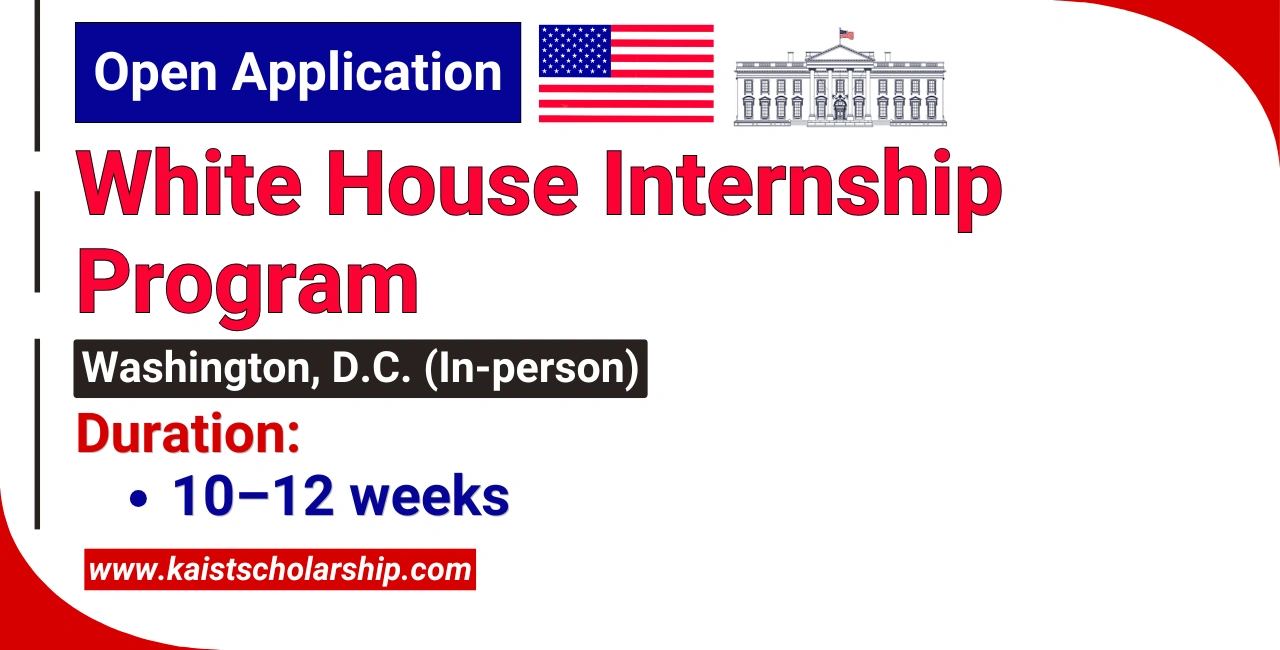
The White House Internship Program Is Accepting Applications — Spring 2027 Deadline Is August 10
Picture this for a moment.
You walk through security. You cross the White House campus. You sit down at a desk inside one of the most recognized buildings in the world and start your workday — attending policy meetings, drafting memos, conducting research for staff who brief the President of the United States.
That’s not a hypothetical. That’s what White House interns actually do.
The White House Internship Program 2027 is now open for applications. The Spring 2027 session deadline is August 10, 2026 — which is closer than it sounds. If this program is on your radar, the time to act is now, not after summer ends.
White House Internship Program Overview
| Program | White House Internship Program 2027 |
| Host | The White House, USA |
| Location | Washington, D.C. (In-person) |
| Duration | 10–12 weeks |
| Sessions | Spring |
| Mode | Full-time, In-person |
| Eligible For | US citizens Only |
| Spring 2027 Deadline | August 10, 2026 |
What the Program Actually Is
The White House Internship Program was created to develop the next generation of public servants — people who understand how government works from the inside, not just from textbooks or news coverage.
Interns are placed across different departments of the White House campus and work directly alongside professional staff on real responsibilities. This isn’t a shadowing program. Interns conduct research, handle inquiries, attend meetings, prepare memos, and support staffing activities — contributing to work that actually moves through the institution.
Three sessions run throughout the year: Spring, Summer, and Fall. Each runs for 10 to 12 weeks, full-time and in-person in Washington, D.C.
The program is equal opportunity. It does not discriminate on the basis of race, sex, color, marital status, or disability.
What Interns Get Out of It
Beyond the work itself, the program includes structured professional development throughout the internship period.
During the program, interns receive:
- Access to work on the White House campus — the physical experience is part of what makes this program unlike anything else
- Weekly events and networking opportunities with interns across all departments
- A speaker series featuring senior officials and public figures
- Professional development programming
- Opportunity to work on volunteer community projects
- Academic credit, if required by your institution
One important note on compensation: The source material for this article does not confirm whether the 2027 program includes a financial stipend. This has varied in previous years depending on the administration. Verify the current compensation status directly on the official White House internship portal before applying.
Who Can Apply
Eligibility is specific, and it’s worth reading carefully before you invest time in the application.
You must:
- Be a US citizen
- Be at least 18 years old
- Pass a security clearance and drug test
And meet at least one of the following:
- Currently enrolled in an undergraduate or graduate program and have completed at least 2 semesters before the internship start date
- Graduated from an undergraduate or graduate program within the last 2 years of the internship start date
- Be a veteran of the US Armed Forces with a high school diploma or equivalent, having served for at least 2 years prior to the internship start date
That third pathway — the veteran track — is one most people overlook entirely. If you’ve served in the military and assumed this program wasn’t designed for you, it is.
Important: The security clearance requirement is real and takes time. Don’t treat it as an afterthought. Flag any potential complications in your background early in the process rather than discovering them after you’ve submitted everything else.
Choosing Your Departments
When completing the application, you select up to 5 departments of interest from across the White House campus. This is one of the most consequential decisions in your application — and one that most guides don’t spend enough time on.
Don’t just select departments that sound impressive. Select departments where your background, skills, and genuine interests create a credible match. A policy research background makes sense for a legislative affairs placement. A communications or journalism background fits the press office. A tech or data background aligns with digital and technology roles.
Reviewers assess fit. A scattershot list of five high-profile offices with no clear connection to your profile reads differently than five selections that tell a coherent story about who you are and what you can contribute.
How to Apply for White House Internship Program
The application process is detailed. Work through it methodically rather than rushing it in one sitting.
- Go to the official White House internship application portal
- Create a new account — or log in if you’ve applied before
- Answer the basic eligibility screening questions
- Fill in your personal details and contact information
- Enter your social media account information
- Answer questions about any previous White House applications
- Enter your complete academic background
- Select up to 5 departments of interest
- List your computer skills and languages
- Upload your resume
- Complete short answer responses about the program
- Upload your memorandum draft
- Provide details for your recommenders
- Upload 2 letters of recommendation
- Review and accept the terms and conditions
- Submit
Documents you’ll need to prepare:
- Resume
- Memorandum draft
- 2 letters of recommendation
- Proof of US citizenship
The Memorandum Draft — Don’t Underestimate It
Most applicants spend the majority of their preparation time on the resume and short answers. The memorandum draft often gets left to the last day.
That’s a mistake.
The memo is a writing sample that demonstrates how you think, how you organize information, and how clearly you communicate — skills that are central to what interns actually do once they’re placed. A weak memo undermines a strong resume. A strong memo can elevate an otherwise average application.
Give it the same attention you’d give any other piece of professional writing you wanted to be proud of.
The Recommendation Letters — Start Early
Two letters of recommendation are required.
The practical reality: the people best positioned to write strong letters for this program — professors, supervisors, senior professionals who know your work — are often the hardest to reach on short notice.
With the Spring 2027 deadline on August 10, 2026, you have a narrow window. Contact your recommenders now. Give them enough lead time to write something specific and credible rather than something generic written under pressure.
A letter that describes your actual work in detail is worth significantly more than a letter that lists your qualities in vague, positive terms.
Application Sessions and Deadlines
The program runs three sessions per year. Only the Spring 2027 deadline has been confirmed at the time of publication.
| Session | Deadline |
|---|---|
| Spring 2027 | August 10, 2026 |
| Summer 2027 | To be announced |
| Fall 2027 | To be announced |
Monitor the official White House internship portal for Summer and Fall 2027 deadlines as they are announced. Deadlines for previous years suggest Summer applications typically open in the autumn and Fall applications in early spring — but these dates are not confirmed for 2027.
Related reading: